Stile

21
Ottobre
2021

Dei pellami di colore divero

Saffiano leather


The history of Saffiano leather


This is a type of leather, used in the fashion industry. The name Saffiano comes from the cross-hatch print, pressed into the wax that covers the leather.

Saffiano leather was produced for the first time in one of the most famous fashion houses in Italy, invented by Mario Prada for many years it characterized the creations of the Maison before being exported all over the world.

Saffiano is a particular texture of calfskin leather, an icon 100% made in Italy, synonymous with beauty and luxury, which today has become a symbol of many collections of bags, belts and wallets of other top brands such as Michael Kors and Lancaster.This particular fabric is very used and requested because it is able to combine its great durability and resistance to any kind of stain in combination with a perfect elegance and class..

Origin of the name


Actually, this leather should be called Saffian, which is the name by which the material has been known for centuries, is the name by which the material has been known for centuries. Saffiano is simply the Italianization of the expression, introduced by the Prada brothers to give their products a slightly more Italian touch.

The leather is named after the Moroccan city of Safi, the material was imported from North Africa for before its complete manufacturing process became known in Europe. The French know Saffiano as Maroquin leather, the French name for Morocco. 

What characterizes Saffiano leather?


The hallmarks of this leather are its stain and scratch resistance and its water repellency.

The range of color choices for this leather is very wide, available in both vibrant and dark tones.
The choice of color does not stop only at the solid color but you can opt for two-tone effect. This can be obtained by applying a solid color to the entire leather and then embossing by applying a second color only in the embossed areas; however, it is important to pay particular attention in this case because due to the shape and the embossing, the secondary color on the reliefs will be more delicate and more exposed to wear, being the first point of contact.

How to take care of it


Saffiano leather is durable and taking care of it to preserve it at its best is not so difficult.

Inside each belt, wallet, briefcase, bag, shoulder bag, Saffiano leather accessory you will find a label that will list and explain how to take care of the object of craftsmanship, with manufacturing strictly Made in Italy.

First it will be necessary to empty our object, in order to remove light stains, small or little invasive will be possible to proceed to cleaning with a simple cloth in soft fabric slightly damp and pass it on the affected area very gently and carefully. 

Dirt, however, could also creep into the grain, so using a simple soft brush and also slightly damp you can go to gently scrub. The important thing is not to apply too much pressure in this step to avoid damaging the luster and grain pattern.
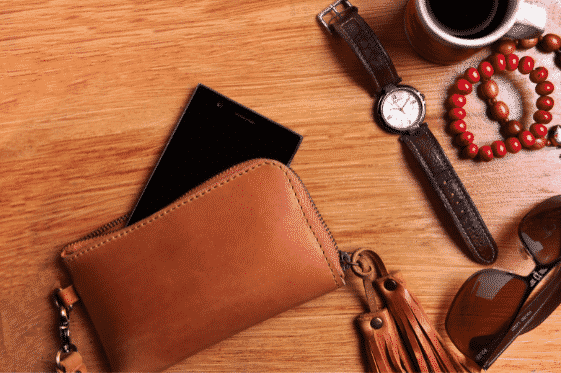
portafoglio e altri accessori in pelle

If there are more important stains it is advisable to use a stain remover specialized for that type of stain.

Usually this type of leather goods, due to their well-known delicacy, are sold with a dust bag, i.e. a special cloth bag to protect them from dust.

When not using the product it is advisable to put it in the bag described above.

You should also pay attention to the place where you store the object, it is advisable to store it in places away from direct sunlight and excessive changes in value.

If you don’t store it in this recommended way, the object could change its aesthetics and durability, the color of the leather could fade and the leather itself could deform.

It is useful to use a specific balm for this type of leather every now and then to keep it soft and preserve its original color and shine.


Recognizing the true from the false


Although Saffiano leather is uniquely recognized, each luxury brand adopts its own production and finishing methodology.

Nowadays there are many fraudsters who try to deceive by trying to recreate this particular plot; in order to understand and analyze a product, to accept that it is not counterfeit it is necessary to pay attention to the smallest details.

For sure this kind of craftsmanship is produced only in Italy: the production and treatment processes are very complicated and are kept by the tanneries of the Toscano district.

What makes it a luxury material is not so much the leather itself but the manufacturing process, with the unique finishing of one leather at a time through 12 finishing steps.

Observe if there is a multi-tone effect that makes the surface optically in relief and not flat through the different coloration that the tips assume with respect to the furrows of the weave.

The machine called mille punte takes care of ensuring this effect.

14
Ottobre
2021

Inseme di pellami colorati con tonalità diverse

Everything you need to know about the world of leather goods

What are the most valuable leathers and how to recognize them


There are different types of leather. The natural product differs depending on the animal, the intended use, the tanning or the type of coloring. It is a fascinating product that has accompanied us, protected us and kept us warm since ancient times. Used in numerous sectors; from design to the automotive industry passing through clothing, leather represents a true art that has been handed down for centuries.  

Why go for leather?

Leather is a noble and natural raw material, mainly used in the production of shoes, furniture, car interiors, clothes and bags. Approximately 500,000 tons of leather are produced each year, the equivalent of about 1.5 billion m².

This material has a technical advantage over alternative materials: one gram of leather has an internal surface area of up to 300 m², its fibers are rich in collagen. 

artigiano che lavora la pelle

Therefore, leather has great resistance to tearing, stretching and bending, is reluctant to age and can absorb up to 30% water without “wetting”.
Can absorb moisture from the inside and direct it to the outside. Insulates against cold and heat. No substitute, no synthetic leather has so many advantages. Especially when it comes to shoes, jackets or gloves, leather clearly offers an unparalleled advantage and comfort.

The variations in leather are amazing, depending on how the dermis is processed we have a different texture and value: Nubuck, velvet, aniline, semi-aniline, pigmented leather, oily leather, suede and more.


Animals


Before talking about the characteristics of the different leathers, let’s review the various types of leather starting from the animal of origin:– Lamb: This is a thin but very resistant leather, protective and insulating, suitable for winter jackets. Loved for its delicacy, given by a smooth and silky surface. Its name is synonymous with quality.

– Sheepskin: Sheepskin has similar characteristics to calfskin but is less noble. The advantage of mutton lies in the fact that its thick wool, gives the leather even more resistance and makes it even warmer. It is therefore ideal for the creation of clothes.

– Cowhide: smooth and thick, cowhide is generally not a leather used for its nobility, we prefer it on rough and masculine jackets, which should naturally improve over time.

Buffalo: a more noble natural grain material than its friend above, buffalo remains relatively expensive and can take many forms. Solid or flexible, depending on its intended use and the treatment used. 

– Crocodile – Aligator: these are undoubtedly the most famous exotic skins. They are expensive, rare and highly sought after by the large clothing industries for making shoes and accessories. 


Le diverse varietà di pelle


– Crust: the crust is a very particular type of leather, as it is not very worked. The tannery does not apply any primer on the leather, in order to reduce chemical treatment to a minimum. This type of leather easily absorbs any type of processing and color, and is particularly used in the clothing and accessories sector.

– Vegetable leather: Today, classic leather is tanned with chrome in particular – the rest of the products is a recipe generally kept secret by the tanneries. However, it is also possible to tan it using natural materials (it is more time-consuming, more expensive and more complicated, but it is possible), so we talk about vegetable tanning. Vegetable tanning is the oldest and most ecological method of treating leather, used for several centuries.– Full-grain leather: Full-grain leather is the most valuable and durable layer of animal skin. This material is the most natural in its class and is unrivaled in quality.

– Sawn grain leather: it is the dermis that has been treated to improve its quality. The benefits are its resistance, nobility and naturalness. Having a product so raw and of such high quality is a guarantee of exceptionality and durability.

 – Nubuck: This is a type of top-grain leather treated in such a way as to give a smooth and velvety feel.

– Suede: A popular type of leather that can be identified by its fuzzy surfaces, suede is commonly made from split leather.

 – Leather split: is the lower part of the leather, the least noble part and the cheapest. It is often used for entry level products of excellent quality.

Now you have all the information you need to improve the quality of your purchases.

Knowing these indications from now on will allow you to distinguish a quality product from one that is defined as such but that is not at all. 

We have always been of the opinion that quality is better than quantity.

7
Ottobre
2021

Delle borse in pelle di varie tonalità

The leather goods


Where does the term leather goods come from? Etymology and curiosity about this word


“Leather goods,” a term used in the past to refer to items made of animal skin, now has several linguistic connotations. In today’s era, leather goods mean much more than just leather items.  As the Universal Encyclopedia web dictionary states: the term also includes the company that produces it, the techniques used to make it, the store that sells it, etc.

What do we find in the world of leather goods?
Today, leather goods are not limited to clothing and carpets. There are also shoes, wallets, belts…and especially handbags. It is precisely the latter that are the most sought after on the market, always monopolizing the first place on the podium of fashion trends. A leather bag is a symbol of luxury, elegance, sturdiness and nobility. Several giants of the Fashion Industry are dedicated exclusively to the production and sale of leather bags

So where does this ancient art, which is gaining importance century after century, come from?

The National Center for Textual and Lexical Resources explains that “leather goods” draws its etymology from the word “Moroccan” or “goatskin”. The term and the know-how were transmitted to Europe by the Spanish, a word they learned in turn from the Muslims, the true inventors of the new practice: “marroqun”.

The genesis of the art of leather goods

It is known that the use of animal skins has very ancient roots in human history. The proof was given by archaeological findings on Egyptian soil: furs, shoes, objects of daily use, musical instruments… all made of leather. And that’s not all. The use of animal skin was also a common practice in ancient Greece: knights and fighters used leather leggings and epaulettes to protect themselves during battles.

Until then, leather goods existed, but with discretion: it was a response to basic needs, including that of protection from the cold and from the enemy in battle. 

Cinture in pelle di colori diversi

It was only at the beginning of the 12th century that leatherworking began to develop, particularly in Italy and in the Maghreb countries. Leather was used in the production of luxury items, bought and worn exclusively by the bourgeoisie, the only social class that could draw on the high price. Fortunately, nowadays leather goods are accessible to everyone and can be purchased by anyone who wants them. It was only at the beginning of the 12th century that leatherworking began to develop, particularly in Italy and in the Maghreb countries.

The leatherworker: from modest worker to expert craftsman


Initially a leatherworker was a simple worker who barely earned enough to live on. But as time went by, leather goods gained importance, the bourgeoisie and the wealthy population became more and more attracted to this trend, which soon became “art”. Nobles of the Middle Ages decorated their interiors with leather objects, especially with trunks and carpets. This phenomenon continued to grow until the 13th century when demand reached its peak and furs became a real must-have, sought after by the middle class. The furriers then became artisans and their creations became objects of common desire.

Leather goods as fashion and glitz

We arrive at the sixteenth century, where leather goods enter the glorious world of fashion. The art of leatherwork became indispensable and no outfit was complete without a leather accessory. Owning a leather item was a matter of wealth, a reason for pride and irreproachable pride.

From utility to aesthetics

Leather goods, which until then had only satisfied the need for protection from the elements, also became an object of aesthetics. For this reason, a leather bag not only had to allow the transport of objects, but also had to be beautiful and elegant.

The baptism of the art of leather goods

Until then, the art of leatherworking had no real name. It was only in 1835 that it was given the name “leather goods”. From that moment on, the leather goods industry began its successful expansion and in the 19th century saw the emergence of the great luxury leather goods brands. Hermès, Louis Vuitton, Lancel and other fashion houses saw the light of day thanks to the production of fine leather goods and at the beginning of the 20th century they created the most popular leather accessory in the world: the bag.

Leather goods for everyone and for all uses
After its success in the world of fashion, the art in question expands also in the field of Design: more and more sofas, headboards, luxury car seats are made with exclusive and refined leather. Thanks to the hardness of this material it is possible to preserve beauty and uniqueness over time. Because leather is not only color or grain, but also softness, texture, characteristic smell and even art.

Today, leather goods continue to be an emblem of elegance and the highest quality: bags, shoes, gloves and leather accessories are synonymous with innovation and refinement, the result of a tradition of craftsmanship that aims at excellence.

28
Luglio
2021

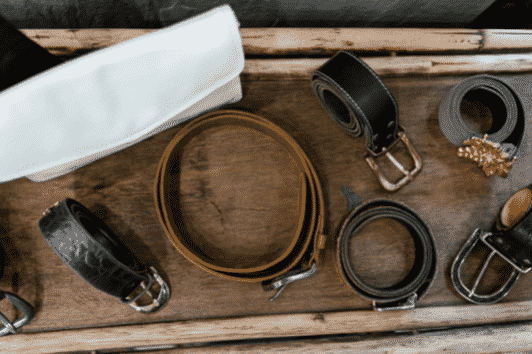
How to match and wear a leather belt


To each his belt

The leather belt Made in Italy is a timeless accessory that can be combined with any look. 

To choose the most suitable model for you pay attention to:

– Size: to make sure your waist is right where you usually wear your belt, alternatively you can rely on the size of your pants (this option is less secure because often there is no match between the sizes of different countries). If you already own a belt but don’t know its size it measures the distance between the most used hole and the end of the buckle.The resulting number will be that of your waist to which you have to add about 15 cm;

– Height: can vary from 30 to 40 mm. The standard provides that the higher a belt is, the more suitable for a casual or sporty look;

– Fastening: usually the belts have 5 holes. To make sure that the belt is perfectly aligned and the buckle is in the center of the pants we recommend using the third hole.

Our belts are handcrafted Made in Italy and are essential leather accessories to complete and enhance any look.

Belt Yes or Belt No

If you are undecided whether to wear the belt or not, pay attention to the details of the dress: do the pants have passers-by? You want to wear your shirt in your pants?In these cases the belt is a must.

To make your look more sophisticated you can match the color of the leather belt to that of the shoes, while the buckle can be combined with the color of the accessories.

Usually the ton-sur-ton is the best choice, but remember that in the case of informal and casual looks, you can get a nice effect playing with contrasts and use different leather belts, such as cowhide or tassel leather.

The belt, of course, is not only a male accessory but can also be used by a female audience and not only with pants. For example, with a long and soft dress in order to enhance the waist;  a particular color contrasting with a total monochrome look, to brighten it up; but also as a finish of outerwear, cardigan or kimono.

Tip: make your outfit even more special, interesting, glamorous, choosing a bag that can be combined or in contrast with the colors of your look.

On our online shop you will find a wide range of belts, bags, suitcases and accessories (wallets, shoulder bags etc) in real Italian leather, suitable for all needs.

Belt Must-have

The belts that you absolutely must have in your wardrobe are two:

For evening dress and formal occasions – belt less than 4 cm wide with small and smooth buckle (gold or silver), black or brown shiny leather, simple and not decorated.

For informal occasions and leisure – belt about 4 cm wide with large buckle, natural leather or matt leather color, brown or blue, can be decorated. It’s the perfect accessory for jeans.

For women’s looks, the rules described above apply taking into account that there is a greater Variety of heights to make the belt even more versatile and can be combined with different clothing.

Why choose a leather belt

A leather belt is an investment, especially if of Made in Italy craftsmanship: It is very strong, it does not break and is not torn; is elastic and softens with the use, adapting better to your physicality, and also resists optimally at any temperature.

If well preserved it is an “eternal” and timeless accessory.


16
Maggio
2018

The beauties of the San Lorenzo market

It is difficult to think of describing the many beauties of the San Lorenzo market in an article of a few lines but we try, because this exhibition space deserves at least one visit, if you are in Florence, and is one of the most particular and typical places where you can meet flavors and genuinely Tuscan perfumes, shopping and having an exceptional setting for your last selfie!

The two sections of the market

The San Lorenzo Market is exactly divided into two parts: one inside, known as the Central Market and dedicated mainly to food, shops, restaurants and fast food, and the other outdoor section, organized around to the Central Market building, a glass and cast-iron structure built towards the end of the 19th century by Giuseppe Mengoni, the architect of the Galleria Vittorio Emanuele in Milan.

A taste experience

Fruits and vegetables, bread and pastry, chocolate and honey, fresh fish, fried meatballs, meat and sausages, cheese, pizza and fresh pasta, wine shop, lampredotto, sorbets and ice creams … All the activities of the Central Market are conducted by artisanal traders that have in common the passion for their profession. Going from here is a real dip in tradition, in good Tuscan and Italian cuisine, with its quality ingredients, a place for gourmets who want to experience a unique, tasteful experience.

It can be a good idea, between a museum and a church, to put on your march the visit to the San Lorenzo Market, perhaps at lunchtime or even for dinner, so as to taste the delicacies of Tuscan cuisine (they are about 500 seats available inside) and let yourself be tempted by the various tastes.

The paradise of the skin

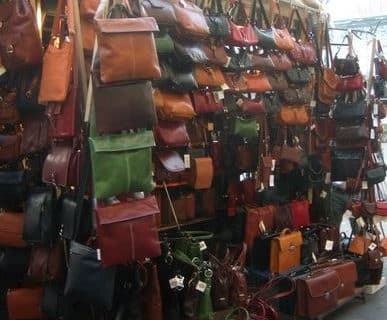
Outside, among the streets that wind around the covered market, you can indulge in admiring leather objects, mostly ceramic artifacts and other local products, clothes, scarves, small ornaments, stationery objects, magnets and all kinds of cadeau to take home as a souvenir of your tour in Florence. But do not forget that at the San Lorenzo Market you can find many leather goods to complete your favorite look: bags, clutch bags, belts, wallets, jackets and jackets. The local craftsmanship here is really on display, it does not seem a gamble to call it “the leather’s paradise”.

You just have to choose

Allow us a tip: if you are willing to make serious purchases, first make a list of what you are looking for, if you need to give gifts, and allow yourself enough time to take a look at the various stalls before deciding what to buy, and plan a “extra budget” for a last deal, just for you!

There are so many options to choose from and without spending too much money, you will certainly find very tasty souvenirs for you and your friends. This part of the San Lorenzo Market is open every day, from Tuesday to Saturday. Enjoy your visit!